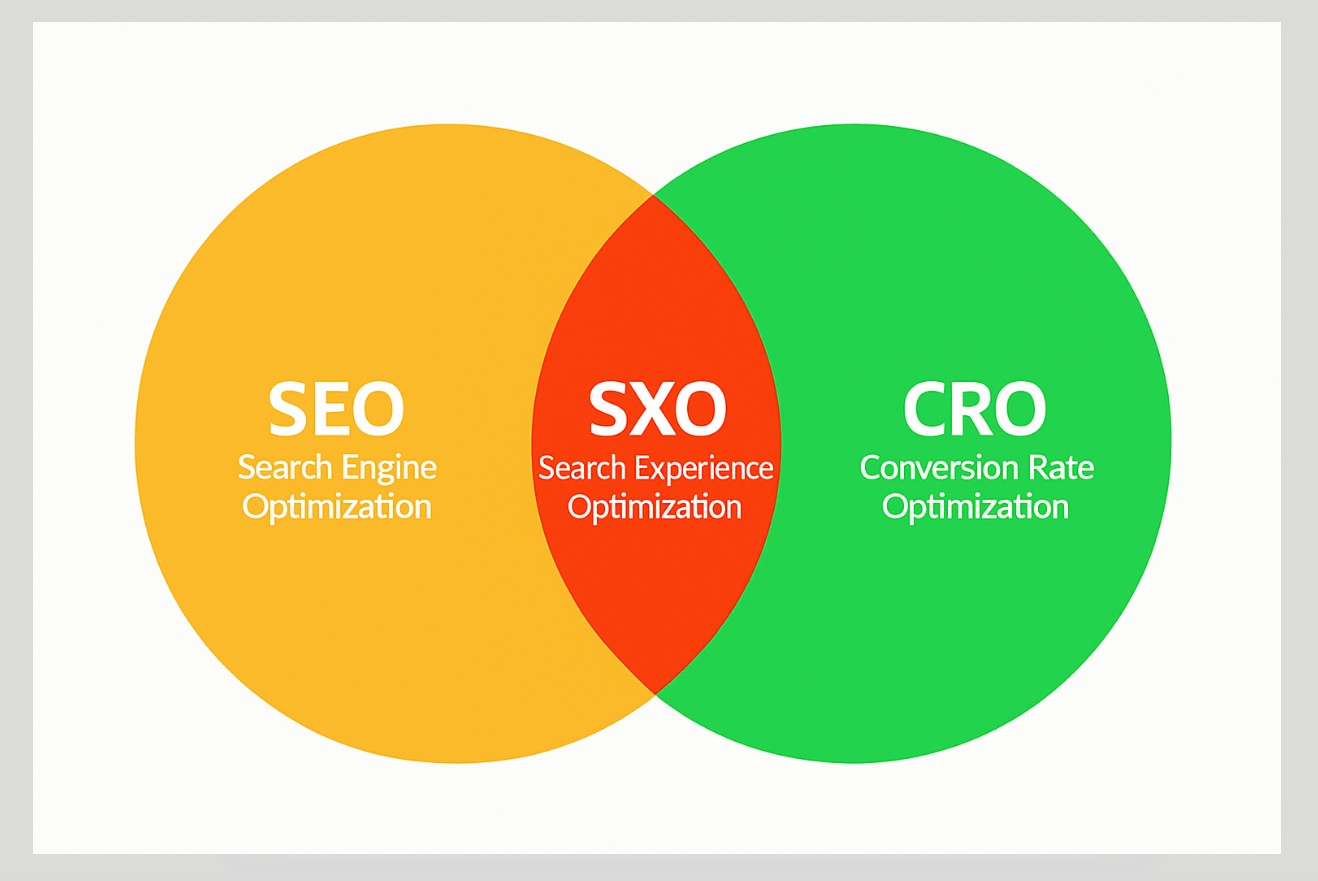
Search Experience Optimization (SXO) brings search engine optimization (SEO), user experience (UX), and conversion rate optimization (CRO) together to improve what happens before and after someone clicks on your website.
A page can attract visitors from Google and still fail to generate enquiries. The problem might be a mismatch between the search query and the page content, a confusing layout, an unclear offer, or a form that asks for too much information. SXO addresses these problems as one connected journey rather than treating rankings and conversions as separate goals.
In 2026, that journey also includes AI-powered search experiences. Google AI Overviews and AI Mode can help people explore a topic before visiting a website. This makes it increasingly important to publish useful, distinctive content that earns attention and gives visitors a reason to explore further.
Google’s guidance remains clear: established SEO fundamentals still apply to its AI search features. There is no separate technical shortcut that guarantees inclusion in AI-generated results. Websites need accessible pages, useful information, clear structure, and a good overall experience.
The objective of SXO is therefore straightforward: help the right people discover your website, deliver the information they expect, and make their next step easy.
What Is Search Experience Optimization (SXO)?
Search Experience Optimization is the process of improving the complete experience between a user’s search and the action they take on a website. It combines three disciplines:
- SEO: Helps search engines discover, understand, and present relevant pages.
- UX: Makes the website easy to navigate, understand, and use.
- CRO: Identifies and removes barriers that prevent visitors from completing valuable actions.
These disciplines work best when they support the same goal.
Consider a company looking for an agency to build an SEO-friendly landing page. The visitor searches Google, compares several websites, and clicks a result promising practical landing page guidance.
If the page opens slowly, repeats generic advice, or hides the information the visitor needs, the experience breaks down. Even if the page ranks well, it may not generate a qualified enquiry.
A stronger SXO approach makes the page fulfil its search promise. It explains what makes a landing page effective, addresses important technical and design considerations, demonstrates the agency’s expertise, and offers a relevant next step.
SXO is not a replacement for SEO. It extends the work beyond attracting a click to understanding whether the website actually helps the visitor.
Why Is SXO Important in 2026?
Search visibility is only one part of digital performance. Businesses also need to understand whether visitors find the information they need, trust the company, and complete meaningful actions.
Three developments make SXO particularly relevant in 2026.
1. Search journeys are becoming more varied
People do not always follow a simple path from a keyword to a website. They may compare several results, ask follow-up questions in an AI-powered search experience, view images or videos, and return to a website later.
Google explains how AI features such as AI Overviews and AI Mode work for website owners. These experiences can surface links to relevant websites, creating opportunities for useful content to reach people exploring more complex questions.
For businesses, this means content should do more than repeat a target keyword. It should answer specific questions, explain important differences, provide evidence, and offer information that helps people make decisions.
2. A search click needs to lead to a satisfying experience
Suppose a user searches for a digital marketing agency that can improve lead generation. They click a result expecting to understand the agency’s services and how those services might solve their problem.
If the landing page contains vague claims but no explanation of the process, relevant examples, or clear contact option, the visitor has little reason to continue.
A better experience connects the search intent to the page’s message, supporting information, and call to action. The visitor should not have to guess what the company does or what happens after submitting a form.
3. Traffic alone does not demonstrate business value
An increase in organic sessions is useful only when interpreted alongside the quality of that traffic and the outcomes it produces.
For example, a page may attract thousands of visitors looking for free templates while the business sells enterprise consulting. Its traffic could grow without generating suitable enquiries.
SXO helps businesses evaluate whether their content attracts the right audience and whether the website makes it easy for that audience to move towards a relevant service, product, or enquiry.
How to Improve SXO: Seven Practical Areas to Focus On
SXO works best when improvements are based on actual search intent, website behaviour, and business objectives. The following areas provide a practical starting point.
1. Match the page to the reason behind the search
Before editing a title or adding keywords, determine what the visitor wants to accomplish.
Someone searching for “what is SXO” needs a clear explanation. A person searching for “SXO agency for lead generation” is more likely to compare providers, services, and expected outcomes.
The page format should reflect that difference.
For an informational query, explain the concept and demonstrate how it works. For a comparison query, provide meaningful distinctions and decision criteria. For a service-related query, explain the service, who it is for, how the engagement works, and how to get started.
Review the actual queries bringing visitors to a page in Google Search Console. Look for mismatches between the intent behind those queries and the information the page provides.
Google’s recommendations for creating helpful, reliable, people-first content are a useful reference when deciding whether a page genuinely serves its intended audience.
2. Deliver the promised answer before asking for an action
Visitors should not have to read several paragraphs of background information before discovering whether a page answers their question.
Place the central answer near the beginning. Then provide the explanation, evidence, examples, and next steps needed to understand the subject properly.
For a service landing page, this usually means explaining the service and its intended outcome early. Supporting sections can then cover the process, deliverables, relevant experience, frequently asked questions, and contact options.
Avoid filling pages with repeated keyword variations or generic introductions simply to increase word count. Additional content is useful only when it resolves a real question or helps the reader make a decision.
This is particularly important when content may be surfaced through AI-powered search. Google’s guidance on optimizing websites for generative AI features in Search emphasises useful, distinctive information and the continued importance of foundational SEO.
3. Make the next step obvious and relevant
A visitor who understands your offer should be able to identify what to do next without searching through the entire page.
The right call to action depends on the page’s purpose. An educational article might direct readers to a related guide. A service page might invite them to discuss a project. A product page might offer a purchase or demonstration option.
Consider a landing page promoting website design services. A button labelled “Submit” gives little context. “Discuss Your Website Project” communicates a clearer purpose.
The form itself also matters. Asking for a name, work email, and a brief description may be sufficient for an initial enquiry. Requiring extensive company information before explaining the service can discourage suitable prospects.
Do not remove every field simply to increase form submissions. Instead, test whether each field helps qualify the enquiry enough to justify the additional effort.
4. Improve real-world loading, responsiveness, and visual stability
A page can look attractive in a design preview but perform poorly on an actual mobile device. Large hero images, unnecessary scripts, third-party widgets, and layout shifts can make it difficult for visitors to read or interact with the page.
Google’s Core Web Vitals provide three useful measures:
- Largest Contentful Paint (LCP): Measures how quickly the main visible content loads. Aim for 2.5 seconds or less.
- Interaction to Next Paint (INP): Measures responsiveness to user interactions. Aim for 200 milliseconds or less.
- Cumulative Layout Shift (CLS): Measures unexpected movement of visible page elements. Aim for a score of 0.1 or less.
These thresholds should be assessed at the 75th percentile of real-world visits, separately for mobile and desktop. Google’s Core Web Vitals documentation explains the metrics and their thresholds.
Start by checking the URLs with the largest traffic or highest commercial value in PageSpeed Insights. If the main image loads slowly, optimise its dimensions and format. If the page responds slowly after a button is clicked, investigate JavaScript and third-party scripts. If content jumps while loading, reserve space for images, banners, and embedded elements.
Do not treat a perfect laboratory score as the objective. Prioritise changes that improve the actual experience without breaking forms, analytics, accessibility, or other important functionality.
5. Write search titles and descriptions that accurately represent the page
The title and search snippet establish what a visitor can expect before clicking. A misleading promise may attract attention initially but create disappointment when the page loads.
For example, a title promising “How to Double Your Landing Page Conversions” creates a strong expectation of evidence and a specific method. If the article only covers basic design suggestions, the promise is unlikely to be fulfilled.
A more accurate title might be “Landing Page Optimization: Improve UX and Conversions.”
Write a distinct, descriptive title for each important page. Make the meta description specific enough to explain what readers will gain, without stuffing it with keywords.
Remember that Google may generate a different search snippet from the page content rather than displaying the meta description exactly as written. Its official guide to controlling search snippets explains how these descriptions are selected.
Review impressions and click-through rate in Search Console to identify pages where the search presentation may need improvement. Interpret the results in context: query intent, ranking position, competition, and changes to the search results page can all affect click-through rate.
6. Connect related pages with useful internal links
Internal links help visitors move from an initial question to the next piece of information they need. They also help search engines discover pages and understand how content relates across a website.
The link works because it appears within a discussion about landing page visibility, not because it has been inserted to increase the number of internal links.
Use descriptive anchor text that reflects the destination. Avoid repeating the same keyword-rich anchor on every page, and do not link to unrelated articles simply because they are available.
For service-led websites, the internal linking structure should also help visitors move naturally from educational content to relevant service information.
7. Use analytics to identify and remove conversion barriers
SXO improvements should be based on evidence rather than assumptions about what users prefer.
Start by establishing the purpose of each important page. An article may be intended to attract relevant organic traffic and lead readers to another resource. A service landing page may be intended to generate qualified enquiries.
Use Google Search Console to examine search queries, impressions, clicks, click-through rate, and average position. Use Google Analytics 4 to understand landing-page sessions, engagement, and key events such as form submissions or purchases.
Then investigate the points where the journey breaks down.
For example, if a service page attracts relevant traffic but few visitors submit its enquiry form, inspect the form on mobile, test every field, check whether the offer is clear, and confirm that the submission process works. If visitors start the form but do not complete it, review whether the required information is excessive or whether errors are difficult to correct.
Run controlled tests when possible. Change one important element at a time, define the success metric in advance, and allow enough data to accumulate before deciding which version performs better.
A higher click-through rate or longer session is not automatically a business improvement. The result that matters depends on the page’s role and the quality of the actions it generates.
How to Measure SXO Performance
A useful SXO measurement framework connects search visibility with the experience visitors have after clicking and the results they deliver.
| Measurement area | What to examine | What it helps you understand |
|---|---|---|
| Search visibility | Impressions, clicks, queries, and average position in Search Console | Whether relevant audiences are discovering the page |
| Search presentation | Click-through rate and search-result relevance | Whether the title and snippet represent the page effectively |
| Page experience | Core Web Vitals, mobile usability, navigation, and form functionality | Whether visitors can use the page without unnecessary friction |
| Engagement | Engaged sessions, landing pages, and relevant next-page journeys in GA4 | Whether visitors interact with the content in ways that fit its purpose |
| Conversion | Form submissions, purchases, qualified leads, and conversion rate | Whether the experience produces meaningful business outcomes |
The best measurement plan also distinguishes between different traffic sources and audience segments. Mobile visitors may encounter different usability problems from desktop visitors, while people arriving from informational queries may behave differently from people searching for a service provider.
Where relevant, connect website enquiries to the CRM to determine how many submissions become qualified leads or customers. This prevents the team from treating every form submission as equally valuable.
For AI-powered search, Google reports eligible traffic from AI Overviews and AI Mode within the overall Web search type in Search Console. This means businesses should evaluate available search and conversion data rather than assume they need a separate tracking system for AI search visibility.
What Are the Benefits of SXO?
The business value of SXO comes from improving the relationship between the audience a website attracts and the experience it delivers.
More relevant organic traffic: Matching pages to the needs behind a query can attract visitors who are more likely to find the content useful.
A clearer customer journey: Logical page structure, descriptive links, and meaningful calls to action reduce the effort required to find information or take the next step.
Better conversion opportunities: Fixing confusing forms, unclear offers, and technical problems can help more suitable visitors complete an enquiry or purchase.
More efficient marketing spend: When organic and paid visitors land on relevant, usable pages, businesses have a better opportunity to turn existing traffic into results instead of relying entirely on acquiring more clicks.
Stronger long-term website value: Useful content, accessible navigation, and a reliable experience help a website serve its audience beyond a single campaign or search visit.
These outcomes are not automatic ranking benefits. Google explicitly states that there is no single page-experience signal that guarantees high rankings. Its systems consider multiple aspects of the overall experience, while prioritising relevant and useful search results.
The practical benefit of SXO is that it aligns website improvements with the needs of users and the objectives of the business.
What Are the Limitations of SXO?
SXO provides a framework for improving website performance, but it cannot guarantee rankings, traffic growth, or a particular conversion rate.
Search visibility remains competitive. A well-designed page may still struggle to rank if competing pages provide stronger information, better evidence, or a closer match to the query.
Conversion behaviour depends on the offer. A clear form cannot compensate for an unsuitable service, an uncompetitive price, or a lack of trust in the business.
Analytics requires interpretation. A high bounce rate may be normal for a page that answers a question immediately. A long session may indicate genuine interest or simply that a visitor cannot find the information they need. Metrics must be interpreted according to the page’s purpose.
Technical improvements can involve trade-offs. Removing scripts may improve performance but affect analytics, personalisation, or other functionality. Changes should be tested before being applied across the site.
Results take time. Search engines need to recrawl and reassess updated pages, while conversion experiments require enough reliable data to support a decision.
For these reasons, SXO should be treated as an ongoing improvement process, not a one-time checklist.
How SXO Can Improve Landing Page Performance
Landing pages make the connection between SEO, UX, and CRO especially clear because they often have a defined purpose, such as generating leads, encouraging registrations, or selling a service.
A successful page must attract the right audience, answer the question that brought the visitor there, establish trust, and provide a relevant next step.
For example, a business searching for an agency to improve organic traffic should be able to understand the agency’s services, the work involved, and the next step without navigating through unrelated content. At the same time, search engines need to be able to access and understand the page.
This is why landing page SEO should not stop at keywords and metadata. The page’s content, technical performance, navigation, and conversion path need to work together.
Frequently Asked Questions About SXO
Is SXO different from SEO?
Yes. SEO focuses on helping relevant pages appear in search results. SXO takes a broader view by considering the experience from discovery through to the visitor’s next action. SEO is one of the core disciplines within SXO.
Does SXO directly improve Google rankings?
SXO is not a single Google ranking factor. Relevant content, technical accessibility, and a good page experience can support search performance, but no SXO method guarantees higher rankings. Google also considers many other signals when determining which pages to show.
Is SXO important for AI-powered search in 2026?
Yes, because people can discover and explore websites through AI Overviews, AI Mode, and traditional search results. Google’s guidance recommends the same foundational SEO practices, including useful original content, accessible pages, strong internal linking, and a good page experience. There is no special markup or separate optimisation that guarantees inclusion.
How do you measure SXO success?
Combine search performance, website experience, and conversion data. Search Console helps measure visibility and clicks, analytics helps evaluate on-site behaviour, and conversion tracking or CRM data helps determine whether visits generate meaningful business outcomes.
Should every website page have a call to action?
No. The next step should suit the visitor’s intent. An informational article may benefit from a related guide, while a service page may need an enquiry form. A strong SXO approach helps users continue their journey without forcing an irrelevant sales action.