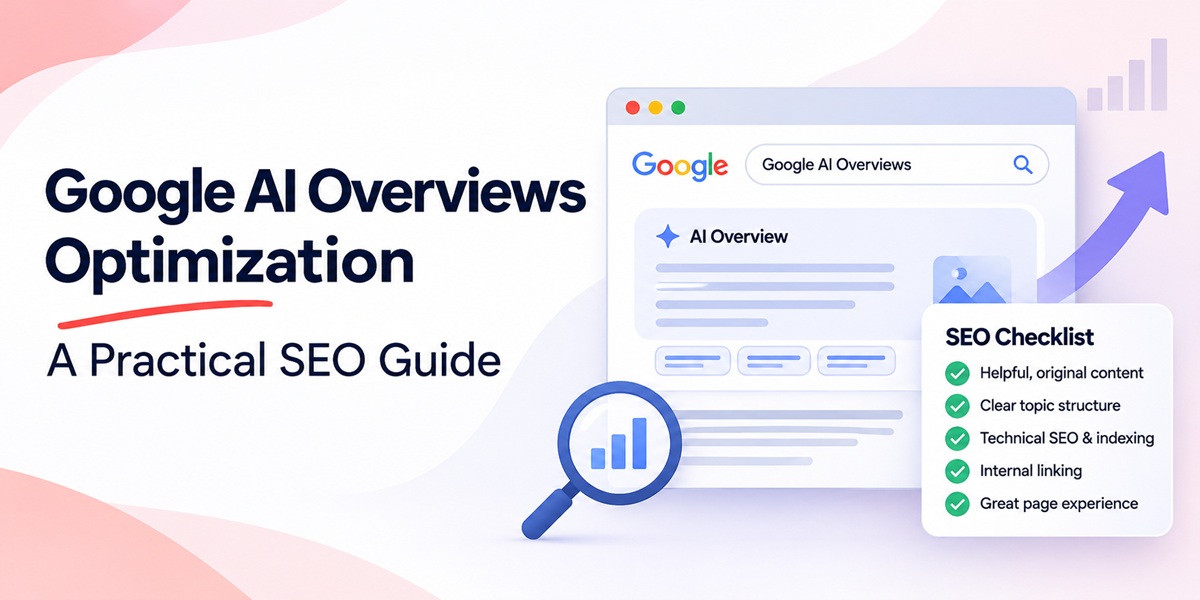
Google Search is changing how people discover information. Instead of showing only a list of website links, Google now uses AI-powered features such as AI Overviews and AI Mode to help users understand topics, compare information and explore more complex questions.
For website owners, this creates a different kind of search opportunity. A page may attract visitors through traditional search results, but it may also be referenced as a supporting source within an AI-generated response.
This has led businesses to look more closely at Google AI Overviews optimization, Answer Engine Optimization (AEO) and Generative Engine Optimization (GEO). However, improving visibility in AI-powered search does not mean abandoning established SEO practices or following a completely different set of technical rules.
Google’s own guidance confirms that the fundamentals of SEO remain relevant. Websites still need accessible pages, useful information, clear content structure and a good user experience. The greater opportunity lies in publishing content that offers something genuinely valuable rather than simply repeating information already available online.
The objective is straightforward: make your website a useful source of information that people and search systems can discover, understand and trust.
What Are Google AI Overviews?
Google AI Overviews are AI-generated summaries that appear for selected searches. They provide an overview of a topic and may include links to websites that support the information presented.
For example, someone searching for ways to improve website conversions may receive a summary covering landing page design, user experience, page speed and conversion optimisation. Google may also display links to relevant articles and resources where the user can explore individual topics in greater detail.
This changes the way people interact with search results. A user may get an initial explanation from an AI Overview before deciding which website to visit.
For businesses and publishers, appearing as a supporting source can create an additional opportunity to reach relevant audiences. However, inclusion is not guaranteed, and there is no publicly documented formula that ensures a page will be selected.
Google explains how these AI features work in its official guide to AI features and your website.
Why Is Google AI Overviews Optimization Important?
Search behaviour is becoming more conversational. People increasingly use detailed questions rather than searching with only one or two keywords. They may also ask follow-up questions, compare alternatives and look for explanations before making a decision.
Consider someone planning to select a digital marketing agency. Instead of searching only for “digital marketing agency”, they might ask:
- How do I choose a digital marketing agency for lead generation?
- What should an SEO agency include in its monthly services?
- How can I measure the return on investment from digital marketing?
- What is the difference between SEO and search experience optimization?
Each question reflects a different stage of the decision-making process.
A website that provides useful explanations across these related topics has more opportunities to serve the visitor’s needs. This is where content depth, topical relevance and a well-connected website structure become important.
Three developments make AI search visibility worth considering.
1. Search journeys are becoming more detailed
People may use Google to understand a subject, compare different approaches and investigate specific questions before visiting a website. Content that explains a topic properly can help users at more than one stage of this journey.
2. Useful information matters more than keyword repetition
Repeating the same keyword throughout an article does not make the page a better resource. A useful article explains the subject, addresses relevant questions and provides information that helps the reader understand what to do next.
3. Website visibility needs to be evaluated beyond rankings
Traditional rankings remain important, but businesses should also examine the quality of visitors, engagement and enquiries generated by their content. A website needs to provide a reason for visitors to continue exploring after they arrive.
How to Improve Your Website for Google AI Overviews
There is no guaranteed AI Overview optimization formula. Google’s published recommendations point towards foundational SEO, helpful content and a technically accessible website.
The following areas provide a practical approach to improving your website’s readiness for AI-powered search.
1. Create Content That Provides More Than General Information
One of the biggest challenges in modern SEO is the amount of similar content published across the internet. Many websites cover the same topics using nearly identical explanations, headings and recommendations.
Publishing another generic article may add little value for readers.
Instead, focus on what your business or publication can contribute that is not easily found elsewhere.
For example, an article about website performance could go beyond listing common optimization tips. It could explain how a slow-loading page affects enquiries, demonstrate how to identify performance issues and discuss the trade-offs involved in removing third-party scripts.
Similarly, a marketing article could include actual campaign observations, practical examples, original research or expert commentary.
Google’s guidance on optimizing for generative AI features specifically encourages websites to create unique, useful and non-commodity content.
The important question to ask before publishing is: would someone learn something useful from this page that they could not easily get from several other articles?
2. Understand Search Intent Before Writing
A page should be created around the information the visitor is actually looking for.
Someone searching for “What are Google AI Overviews?” needs a clear explanation of the feature. A person searching for “Google AI Overviews optimization checklist” is likely looking for practical steps to improve a website.
These searches are related, but the expectations are different.
Before preparing an article, examine the search results and identify:
- What information users expect to find.
- Whether the intent is informational, commercial or transactional.
- Which related questions are important to the topic.
- What existing pages are missing or explaining poorly.
- Whether the article needs examples, comparisons or step-by-step guidance.
Google Search Console can help identify the queries already bringing visitors to your website. Compare those queries with the actual content on the page to identify gaps or mismatches.
A strong article should fulfil the expectation created by its title and search snippet. Avoid promising a detailed guide if the page contains only a short overview.
3. Organise Content Around Clear Topics and Questions
Content structure helps readers understand a subject without having to search through the entire page.
Use a clear main heading, followed by logical sections that explain different aspects of the topic. Each section should have a meaningful purpose.
For example, an article about AI Overviews can naturally cover:
- What Google AI Overviews are.
- How they affect website visibility.
- How Google accesses website content.
- Why technical SEO remains important.
- How to create useful and original content.
- How to measure search performance.
When a section addresses a specific question, explain the main point early and then provide supporting information, examples and context.
Use bullet points when listing steps or requirements. Comparison tables can help when readers need to evaluate different options. Neither format should be forced into every article.
The aim is not to make every paragraph short for AI systems. It is to make the information easy for people to follow.
4. Build Topical Authority Through Related Content
A website should not depend on one article to cover every aspect of a broad subject.
A more effective approach is to develop related content that explores different parts of the same topic. These articles should answer distinct questions and provide additional information rather than repeating the same material.
For example, a website focusing on SEO and digital marketing could develop a content cluster around:
- Search Experience Optimization (SXO).
- Google AI Overviews optimization.
- Technical SEO and website indexing.
- Internal linking and content architecture.
- Core Web Vitals and page experience.
- Measuring organic search performance.
These articles can be connected through relevant internal links.
Vidisha’s article on Search Experience Optimization (SXO) explains why search visibility should be connected with user experience and conversion outcomes. This is particularly relevant as AI-powered search changes how people discover and evaluate websites.
The purpose of topical coverage is not to publish as many articles as possible. It is to create a useful collection of resources that helps visitors understand a subject from different perspectives.
5. Make Sure Google Can Crawl and Index Your Pages
Even well-written content cannot perform in Google Search if the search engine cannot access or index the page.
Technical SEO remains an essential part of AI search visibility.
Start by checking whether important pages are accessible to Googlebot. Review robots.txt rules, noindex directives, canonical tags and server responses to identify anything that could prevent a page from being indexed.
An XML sitemap should contain the important canonical URLs that you want search engines to discover. Internal links should also make it easy for visitors and search engines to reach relevant pages.
Google Search Console is useful for checking URL indexing status, identifying crawling issues and reviewing how Google sees a page.
Pay particular attention to:
- Pages blocked unintentionally by robots.txt.
- Incorrect canonical tags.
- Duplicate or very similar content.
- Broken internal links.
- Pages returning server errors.
- Important pages with no internal links.
- Content that is available only through elements Google cannot properly access.
Google confirms that a page must be indexed and eligible to appear with a search snippet to be considered for supporting links in AI Overviews and AI Mode. Meeting these requirements does not guarantee that Google will crawl, index or display the page.
6. Use Structured Data Where It Is Relevant
Structured data helps search engines understand specific information on a webpage. Depending on the content, suitable schema types may include Article, Organization, LocalBusiness, Product or BreadcrumbList.
However, there is an important distinction between using structured data for SEO and expecting it to secure an AI Overview appearance.
Google does not require special AI Overview schema. Adding extra markup simply to target AI-generated search results does not guarantee visibility.
Use structured data when it accurately describes information that is present on the page. Keep author details, dates, product information and other properties consistent with the visible content.
You can validate supported structured data using Google’s Rich Results Test.
7. Improve Internal Linking and Website Navigation
Internal links help visitors discover related information and help search engines understand how different pages on a website connect.
For example, a reader exploring AI Overviews may also want to understand technical SEO, content quality or search experience optimization.
A relevant link within the discussion gives the reader a natural next step.
Use descriptive anchor text that explains what the linked page covers. Avoid inserting links simply to increase the number of internal links or repeating the same keyword-rich anchor across multiple pages.
For businesses, internal linking should also connect educational content with relevant service pages. A visitor who learns about a digital marketing problem should be able to find the related service without navigating through unrelated sections of the website.
8. Demonstrate Experience and Build Trust
Readers need to understand why they should trust the information on a website.
An article should provide clear information about its author or publishing organisation. Where relevant, include professional experience, original observations, research and examples that support the recommendations.
For business websites, accurate contact information, clear service descriptions and genuine company details also contribute to a more credible experience.
Avoid creating artificial author profiles or adding unsupported claims about expertise. Trust should come from the quality of the information and the evidence provided.
External references should also be selected carefully. Link to official documentation, research papers, recognised industry organisations or other reliable sources when they support an important statement.
Backlinks and brand mentions can contribute to discovery and reputation, but there is no universal domain-authority score or fixed number of backlinks that guarantees inclusion in AI Overviews.
9. Optimise Images, Videos and Page Experience
Search visibility is not limited to written content. Relevant images and videos can help explain a subject and provide additional ways for visitors to engage with a page.
Use images that support the information rather than adding unrelated stock photographs. Write descriptive alt text for meaningful images, use suitable file formats and avoid unnecessarily large image files.
For video content, provide a clear title and description, along with captions or a transcript where appropriate.
The overall page experience matters as well. A page that loads slowly, shifts unexpectedly or displays poorly on mobile devices can make it difficult for visitors to use.
Review Core Web Vitals, mobile responsiveness, navigation and the usability of forms and interactive elements. The goal is to make the website easy to access and understand, not simply to achieve a perfect score in a testing tool.
10. Measure Performance Using Search Console and Analytics
Optimisation should be evaluated through actual website performance rather than occasional manual searches for a particular keyword.
Google Search Console helps website owners understand search impressions, clicks, queries and indexing issues. Google Analytics can provide additional information about landing-page sessions, engagement and conversions.
Google’s Search documentation also describes a Generative AI performance report in Search Console, which can help eligible site owners review visibility in generative AI search features.
For businesses, the measurement process should go beyond traffic. Track whether visitors submit enquiries, request information, purchase products or complete other meaningful actions.
A page that attracts fewer visitors but generates more relevant enquiries may be more valuable than a page with high traffic and little business impact.
What Should You Avoid When Optimising for AI Overviews?
As interest in AI search grows, many optimization techniques are being promoted as shortcuts. Some are unnecessary, while others can lead to poor content decisions.
A few common misconceptions are worth addressing.
There is no guaranteed word count. A longer article is not automatically more useful. The appropriate length depends on the topic and what the reader needs to understand.
You do not need to repeat every long-tail keyword variation. Write naturally and cover the subject properly. Google’s systems can understand related language and the broader meaning of a query.
There is no special AI Overview schema. Continue using structured data where it is relevant, but do not add unnecessary markup in the expectation that it will secure an AI citation.
Creating an llms.txt file is not a Google ranking requirement. Google’s published guidance says that special AI text files such as llms.txt are not required for visibility in Google Search’s generative AI features.
Publishing multiple similar articles does not automatically build authority. Creating separate pages for every minor variation of a search query can result in repetitive content that offers little additional value.
The better approach is to focus on useful content, sound technical SEO and a satisfying experience for visitors.
How to Measure Google AI Overviews Visibility
Measuring AI search visibility requires more than checking whether your website appears in a manually generated response.
Search Console should be one of the main tools in your reporting process. Review the available generative AI performance data, along with overall search impressions, clicks and query trends.
Google Analytics can help you understand what visitors do after arriving on your website. Compare organic landing pages, engagement and conversions over time.
For a business website, a useful measurement framework includes:
| Measurement area | What to review | Why it matters |
|---|---|---|
| Search visibility | Impressions, clicks and queries | Shows whether relevant users are discovering your pages |
| AI search visibility | Available generative AI performance data | Helps assess visibility in Google’s AI search experiences |
| Content performance | Landing-page sessions and engagement | Shows whether visitors find the information useful |
| Website experience | Mobile usability and Core Web Vitals | Identifies technical and usability problems |
| Business outcomes | Enquiries, qualified leads and conversions | Connects search visibility with business value |
Do not assume that every organic visit can be attributed to a particular AI Overview appearance. Use the reporting available from Google and interpret performance alongside other website data.
Frequently Asked Questions About Google AI Overviews Optimization
Is Google AI Overviews optimization different from traditional SEO?
Not entirely. Google confirms that its established SEO practices remain relevant for AI Overviews and AI Mode. The focus should remain on crawlable pages, helpful content, clear website structure and a good user experience.
Does adding FAQ schema help a website appear in AI Overviews?
There is no guarantee that FAQ schema will help a page appear in AI Overviews. Use structured data only when it accurately represents the visible content and is supported by Google’s guidelines.
How long does it take for a website to appear in AI Overviews?
There is no fixed timeline. Google needs to crawl and index eligible content, and inclusion in an AI Overview depends on its systems and the search query. Indexing a page does not guarantee that it will be selected.
Does Google prefer long articles for AI search?
No specific article length guarantees visibility. A page should be as detailed as necessary to answer the reader’s question. Avoid adding unnecessary paragraphs simply to increase word count.
Are AEO and GEO the same as SEO?
AEO stands for Answer Engine Optimization, while GEO stands for Generative Engine Optimization. These terms are commonly used to describe work intended to improve visibility in AI-powered search experiences. Google’s guidance explains that its existing SEO fundamentals continue to apply to these experiences.
Can a new website appear in Google AI Overviews?
A new website is not automatically excluded. However, its pages need to be accessible, indexed and eligible to appear in Google Search. Publishing original, useful information and establishing a sound technical foundation are sensible starting points.
How can I track AI search performance?
Use Google Search Console’s available generative AI performance reporting, alongside the regular Search performance report. Google Analytics can help evaluate visits, engagement and conversions after users reach your website.
Final Thoughts
Google AI Overviews are changing how people interact with search results, but the fundamentals of building a useful website have not changed.
Businesses should focus on publishing original information, explaining topics clearly, improving technical accessibility and connecting related content through meaningful internal links. A website also needs to deliver a good experience after someone clicks through from search.
Rather than trying to find a shortcut into AI-generated responses, build a website that deserves to be discovered and referenced.
The long-term opportunity is not simply to appear in an AI Overview. It is to become a useful resource that helps the right audience understand a subject, evaluate options and take the next step.
For businesses looking to improve their digital presence, this means bringing SEO, content strategy, website experience and conversion objectives together rather than treating them as separate activities.