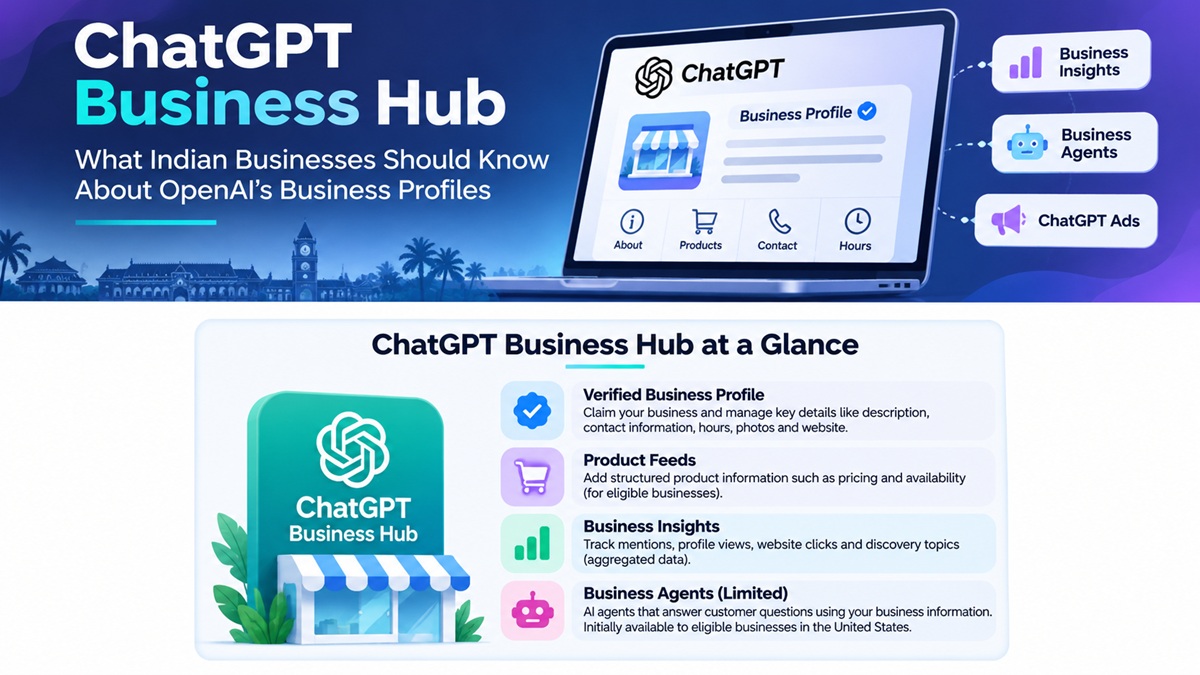
OpenAI is giving businesses a new way to manage how they appear in ChatGPT. On November 10, 2026, the company introduced Businesses in ChatGPT, a beta experience that allows eligible businesses to claim and verify a profile, update business information, share product details and view aggregated engagement insights through Business Hub.
The announcement is important because people increasingly use AI tools to research companies, compare products and explore services. OpenAI says ChatGPT is used by 1.2 billion people each week, creating a new opportunity for businesses to make their information available within AI-powered discovery.
But what does this launch actually mean for businesses in India? Can an Indian company claim its profile? Is Business Hub similar to Google Business Profile? Can digital marketers use its insights to measure AI visibility?
This guide explains the new feature, its current availability, the difference between business profiles and Business Agents, and the practical steps Indian businesses can take to prepare.
What Is ChatGPT Business Hub?
ChatGPT Business Hub is the business management area associated with OpenAI’s new Businesses in ChatGPT experience. It gives eligible businesses a way to claim their presence, verify ownership or authority to represent the company, and manage information displayed in ChatGPT.
Once a business is verified, it can update relevant details and, where supported, provide product feeds containing information such as product pricing and availability.
The feature has three main components:
1. Verified Business Profiles
Businesses can claim their profile and update important information, helping ChatGPT present more accurate and current details when users ask about their products or services.
The information may include business details, descriptions, photos, services, contact information and relevant links. Businesses must ensure that the information they submit is accurate and that they are authorised to manage the profile.
2. Business Insights Dashboard
Business Hub provides aggregated insights into how people engage with a business in ChatGPT.
OpenAI has highlighted metrics and information such as:
- Mentions: How often the business is mentioned in ChatGPT.
- Website clicks: Clicks that take users to the business website.
- Discovery topics: Common themes across conversations where the business website is cited.
These insights can help businesses understand how they are appearing in AI-powered discovery and identify subjects that may deserve more attention on their websites.
The data is aggregated. OpenAI says it does not share individual users’ conversations or Business Agent chats with businesses. Insights are available only when interaction levels meet certain minimum thresholds.
3. Business Agents
Business Agents are a separate capability that allows eligible businesses to create an AI-powered agent to answer customer questions using information supplied by the business.
For example, a customer exploring an online store could ask about product differences, available options or relevant policies. The Business Agent can respond using the business’s information and guidelines.
These conversations are clearly labelled and remain separate from ChatGPT’s independent answers.
Business Agents are initially available to eligible e-commerce and online service businesses in the United States. They are not a feature that every business claiming a profile can automatically use.
OpenAI has also introduced the option for businesses to sponsor their Business Agents as destinations for ChatGPT Ads. Sponsored placements are labelled separately from ChatGPT’s regular responses.
Is ChatGPT Business Hub Available in India?
This is one of the most important questions for Indian businesses.
OpenAI says eligible businesses located in countries where ChatGPT is available can claim their business through Business Hub. India is among the countries where ChatGPT is available, so Indian businesses may be eligible to apply.
However, availability should not be confused with automatic approval. OpenAI states that eligibility depends on factors including business category, location, verification and integrity checks. Not every business will necessarily be able to claim a profile immediately.
The distinction between claiming a business profile and using a Business Agent is particularly important.
| Feature | Current position for Indian businesses |
|---|---|
| Claiming a business profile | Eligible businesses in supported locations can apply |
| Updating business information | Available after the required verification and approval |
| Product feeds | Available to eligible businesses and retailers |
| Business Insights | Available to verified businesses when sufficient data is available |
| Business Agents | Initially limited to eligible businesses in the United States |
| Sponsored Business Agents | Connected to the Business Agent experience; not a general India-wide feature |
OpenAI has said it plans to expand Businesses in ChatGPT and Business Agents to more markets and categories. However, it has not announced a specific India launch date for Business Agents.
Businesses should check the official ChatGPT Business Hub to see which claiming and verification options are currently available to them.
Which Indian Businesses Should Prepare for ChatGPT Business Profiles?
The launch is relevant to several types of businesses, but their immediate opportunities may differ.
E-commerce Businesses
Online retailers have a clear reason to prepare for Business Hub. Product information, pricing and availability are important when customers use ChatGPT to research and compare products.
Businesses should review their product catalogue, descriptions, prices, product images and availability information. Shopify merchants have an additional integration route: OpenAI says eligible Shopify products are already integrated through Shopify Catalog, and merchants can connect their stores through Shopify or Business Hub.
For Indian online stores, maintaining accurate product information will be an important preparation step.
Digital Marketing Agencies
Agencies can help clients prepare their websites and business information for AI-powered discovery.
This work goes beyond adding keywords to pages. It includes improving brand information, building topical authority, creating useful service pages, maintaining consistent business details and making important website content accessible to search engines and AI systems.
Agencies should also understand how to interpret Business Hub insights once clients become eligible.
Educational Institutes and Training Businesses
Schools, colleges, coaching centres and professional training institutes can prepare by reviewing the information available about their courses, locations, admissions, faculty, contact details and services.
A prospective student may use ChatGPT to compare courses, understand eligibility or find an institute offering a particular programme. Clear and consistent information across the website and other trusted sources can help people understand what the institution offers.
This does not guarantee that an institute will be recommended by ChatGPT, but it improves the quality of the information available about the organisation.
Local Businesses and Service Providers
Restaurants, clinics, consultancies, repair businesses and other local service providers should pay attention to the eligibility rules shown in Business Hub.
OpenAI’s announcement does not establish that every local business category in India can claim a profile immediately. Businesses should check the live claiming process rather than assume that all local listings are supported.
In the meantime, keeping business information accurate across the website and established business directories remains useful.
ChatGPT Business Hub vs Google Business Profile
The new Business Hub may remind businesses of Google Business Profile because both involve managing business information and improving how a company is represented on a major discovery platform.
However, they are not the same product and should not be treated as interchangeable.
| Comparison | ChatGPT Business Hub | Google Business Profile |
|---|---|---|
| Platform | ChatGPT | Google Search and Maps |
| Main purpose | Manage business information and understand engagement in ChatGPT | Manage a business’s presence in Google Search and Maps |
| Business verification | OpenAI’s business claiming and verification process | Google’s Business Profile verification process |
| Performance information | Mentions, website clicks and discovery topics | Google profile performance and interactions |
| Product information | Product feeds for eligible businesses | Product and business information through supported Google features |
| AI discovery | ChatGPT responses and business profiles | Google’s search results and AI experiences |
The important point is that claiming a ChatGPT profile does not replace an existing Google Business Profile.
Businesses should maintain both independently and ensure that their core information is consistent.
For example, a company should avoid having different business names, contact numbers, addresses, opening hours or service descriptions across its website and business profiles.
This is part of maintaining consistent business information and supporting local SEO.
Businesses can refer to Google’s official Business Profile verification guidance for managing their Google listing.
How ChatGPT Business Hub Can Change Digital Marketing
The introduction of Business Hub gives digital marketers another source of information about how brands appear in AI-powered discovery.
Until now, marketers have had limited direct reporting from AI platforms. The new insights provide some additional visibility, although they do not offer a complete picture of how ChatGPT users discover or evaluate a brand.
Here are four areas where marketers should pay attention.
1. Measuring AI Search Visibility
Traditional SEO reporting often focuses on organic impressions, clicks, rankings and conversions.
Business Hub introduces additional signals, including business mentions, website clicks and discovery topics.
These metrics can help marketers understand whether their business is being mentioned and which themes are associated with its website.
However, they should not be treated as a replacement for Google Search Console or GA4. Each platform measures a different part of the customer journey.
2. Using Discovery Topics for Content Planning
Discovery topics may be particularly useful for content strategists.
If Business Hub shows that a website is cited in conversations around a particular subject, marketers can investigate whether the website has a sufficiently useful page covering that subject.
For example, a digital marketing agency might discover that its website is associated with conversations about:
- Technical SEO audits
- Website redesign
- Local SEO
- Search experience optimisation
- Lead generation
- AI search visibility
These themes can become starting points for content research. The next step is to identify the actual questions users need answered and create useful pages rather than publishing multiple articles targeting nearly identical keywords.
3. Understanding Generative Engine Optimisation (GEO)
Generative Engine Optimisation, commonly called GEO, refers to improving how a brand, its information and its content are represented in AI-generated answers.
It is related to traditional SEO, but the focus extends beyond ranking a webpage for a particular search query.
A practical GEO strategy includes:
- Publishing original and useful content.
- Maintaining accurate brand and business information.
- Building clear service and product pages.
- Supporting important claims with reliable information.
- Using descriptive headings and logical content structure.
- Making important website pages accessible to search engines.
- Building relevant brand mentions and authoritative references.
GEO should not be treated as a shortcut to guaranteed AI recommendations. No profile, schema markup or content format guarantees that ChatGPT will mention a business.
4. Connecting AI Visibility with Website Analytics
Business Hub website clicks can provide another reference point for understanding traffic from ChatGPT.
Marketers should compare the available Business Hub click information with website analytics, including GA4 referral traffic.
However, the numbers may not match exactly. Different reporting systems can use different attribution methods, date ranges and measurement rules.
A sensible reporting process is to monitor:
- Business Hub mentions.
- Business Hub website clicks.
- GA4 sessions from ChatGPT referrals where identifiable.
- Landing pages receiving AI referral traffic.
- Enquiries and conversions generated by those visits.
This creates a more useful picture than looking at mentions alone.
How to Claim Your Business on ChatGPT
The claiming process may change as the beta develops. The general starting point is to use OpenAI’s Business Hub and follow the verification instructions presented for your business.
Step 1: Open Business Hub
Visit chatgpt.com/business-hub and sign in to your ChatGPT account.
Step 2: Search for Your Business
Look for your existing business profile. If the platform provides an option to add a business, follow the eligibility instructions before creating a new listing.
Make sure you are selecting the correct company and not another business with a similar name.
Step 3: Complete the Verification Process
OpenAI requires businesses to verify that they own or are authorised to represent the organisation.
The verification options and supporting information may vary depending on the business and location. Follow the methods shown in the live Business Hub process.
Step 4: Update Your Business Information
Once the claim is approved and the required verification is complete, review the available profile fields.
Prepare accurate information about your:
- Business name and description.
- Products and services.
- Contact details.
- Business location or service area.
- Website and relevant links.
- Photos and brand assets.
- Policies and other applicable business information.
Only submit information that accurately represents the business.
Step 5: Review Product Feed Options
Eligible retailers can provide product feeds containing details such as product information, pricing and availability.
If you operate an online store, review your product catalogue and ensure that the information is accurate before connecting a feed.
Step 6: Monitor Business Insights
After the profile is active and sufficient interaction data is available, review the insights provided by Business Hub.
Use the information to identify how your business is represented and where your website content may need improvement.
Important: OpenAI’s policies state that only a business owner or an authorised representative may manage a business profile. Claiming a profile also does not guarantee higher placement or more sales in ChatGPT.
What Should Indian Businesses Do Before Business Hub Expands?
Businesses do not need to wait for every feature to become available before preparing their websites.
There are several practical improvements that can support both traditional search visibility and AI-powered discovery.
1. Improve Brand and Entity Consistency
An entity is a recognisable business, organisation, person or product that search and AI systems can associate with information across different sources.
Make sure the business name, website, contact details, services and description are consistent across your website, social profiles and relevant directories.
Avoid maintaining different versions of your company information across multiple platforms.
2. Add Relevant Structured Data
Structured data helps search engines understand the information presented on a webpage.
Depending on the business, relevant schema types may include:
- Organization
- LocalBusiness
- Product
- Service
- BreadcrumbList
The markup should accurately describe the visible page content. Adding schema does not guarantee inclusion in AI-generated answers, but it can help search engines interpret important information.
Refer to Google’s LocalBusiness structured data documentation for implementation guidance.
3. Make Important Website Pages Accessible
Check that important pages can be crawled and indexed.
Review:
- Robots.txt rules.
- XML sitemap configuration.
- Canonical tags.
- Internal linking.
- Page status codes.
- Mobile usability.
- Duplicate or low-value pages.
A business website should make its core information easy to discover. This includes the homepage, service pages, product pages, contact page and important supporting guides.
4. Create Useful, Answer-Focused Content
Businesses should create pages that answer real customer questions.
For example, a web design agency could publish practical guides covering website redesign costs, landing page optimisation, technical SEO and website performance.
An e-commerce business could create detailed product guides, comparison pages, sizing information, delivery explanations and product FAQs.
The objective is to provide information that is genuinely useful, not to repeat AI-related keywords across every page.
5. Keep Business Information Updated
Outdated information can create confusion for both customers and platforms.
Review your website and business listings regularly, particularly when changing:
- Services or product categories.
- Business locations.
- Contact numbers.
- Pricing.
- Opening hours.
- Delivery and return policies.
For e-commerce businesses, product availability and pricing deserve particular attention.
ChatGPT Business Hub Is Not a Replacement for SEO
One misconception businesses should avoid is assuming that claiming a profile will automatically improve their visibility in ChatGPT.
OpenAI explicitly states that claiming a business does not guarantee higher placement or sales. ChatGPT continues to make independent recommendations and comparisons.
This means businesses still need a strong website, useful content, accurate information and a consistent digital presence.
Traditional SEO remains relevant because websites need to be discoverable, accessible and informative. GEO and Answer Engine Optimisation (AEO) should build on these foundations rather than replace them.
For businesses planning a broader search strategy, Search Experience Optimisation (SXO) is also worth understanding. SXO connects search visibility with the experience visitors have after reaching a website, including content usefulness, navigation, page performance and conversion opportunities.
Skills Digital Marketers Should Build for AI Search
The introduction of Business Hub highlights why digital marketing professionals need to understand more than traditional keyword research and ranking reports.
Four skill areas are becoming increasingly relevant.
GEO and AEO: Understand how AI-powered search experiences present information and how to make business content clear, useful and trustworthy.
Technical SEO and structured data: Learn how crawling, indexing, schema markup, product feeds and website architecture affect search visibility.
Analytics and attribution: Understand GA4, referral traffic, conversion tracking and how to compare performance information across platforms.
Content strategy and entity optimisation: Build topic clusters, improve brand information, create useful resources and maintain consistency across the digital presence.
For agencies, these capabilities also create opportunities to offer AI-search readiness assessments, structured data implementation, content audits and ongoing visibility reporting.
Conclusion: Prepare Your Business for the Next Stage of AI Search
OpenAI’s Businesses in ChatGPT launch introduces a new way for eligible companies to manage their information and understand how people discover them through ChatGPT.
For Indian businesses, the immediate opportunity is to check Business Hub eligibility, improve the accuracy of their online information and prepare their websites and product data. Business Agents remain limited to eligible US businesses for now, but OpenAI has indicated that it plans to expand the experience.
For digital marketers, this is another reason to develop practical skills in SEO, GEO, AEO, technical optimisation and analytics.
The businesses best prepared for AI-powered discovery will not necessarily be those that publish the most AI-related content. They will be the ones that provide accurate information, useful answers and a consistent experience across the platforms where customers research and make decisions.